
The best time to visit Lingaraj Temple is between October and March, when the weather in Bhubaneswar is cool, pleasant, and ideal for both sightseeing and darshan. The temple is open daily from 6:00 AM to 12:30 PM and again from 3:30 PM to 9:00 PM. For the most spiritually rewarding experience, plan your visit during Maha Shivaratri or Ashokashtami, when the temple comes alive with an energy unlike any other time of the year.
Standing at the heart of Bhubaneswar in Odisha, the Lingaraj Temple is one of the oldest, largest, and most revered Shiva temples in India. Dedicated to Lord Harihara — a combined form of Lord Shiva and Lord Vishnu — this 11th-century masterpiece of Kalinga architecture draws thousands of pilgrims and heritage travellers every single day. Understanding the best time to visit Lingaraj Temple helps you plan around both the weather and the rich festival calendar that defines life at this ancient shrine.
Confused where to go for quick escape? Let us plan it for you.
Grab the Best DealTable of Contents
Quick Reference: Lingaraj Temple Visit Planner
Here is a handy snapshot of everything you need to know before planning your trip.
| Detail | Information |
|---|---|
| Temple Name | Lingaraj Temple (Lingaraja Temple) |
| Location | Rath Road, Lingaraj Nagar, Old Town, Bhubaneswar, Odisha 751002 |
| Deity | Lord Harihara (Shiva and Vishnu combined) |
| Built By | King Jajati Keshari of the Somavamsi Dynasty |
| Architecture | Kalinga / Deula Style |
| Temple Height | 180 feet (55 metres) |
| Darshan Timings | 6:00 AM – 12:30 PM and 3:30 PM – 9:00 PM (daily) |
| Entry Fee | Free |
| Best Season | October to March |
| Key Festivals | Maha Shivaratri, Ashokashtami, Chandan Yatra, Kartik Purnima |
| Nearest Airport | Biju Patnaik International Airport (~3 to 4.4 km) |
| Nearest Railway Station | Bhubaneswar Railway Station (~4 to 5 km) |
| Non-Hindu Visitors | Not permitted inside; viewing platform available at the north gate |
Best Time to Visit Lingaraj Temple
The best time to visit Lingaraj Temple is during the cooler months between October and March. Bhubaneswar can be intensely hot and humid from April through September. The winter months bring manageable temperatures, lower humidity, and a comfortable experience for pilgrims walking through the large open courtyard. The festival season also peaks during this period, making October to March the most rewarding window in almost every respect.

October to March: Best Season Overall
Temperatures during this season generally range between 15°C and 30°C, with cool mornings and mild afternoons. Roads across Odisha are at their best, and connectivity from cities like Kolkata, Hyderabad, and Chennai is smooth. For pilgrims combining Lingaraj with Puri’s Jagannath Temple or the Konark Sun Temple, this window allows you to cover multiple destinations comfortably. If you are looking to go beyond the well-known circuit, Odisha also has some remarkable offbeat places worth exploring that are best visited in this same season.
February to April: Peak Festival Season
This is the most spiritually charged window at Lingaraj Temple. Maha Shivaratri in February or March draws lakhs of pilgrims in a single day — the complex is illuminated, the Mahadipa is lifted atop the spire at night, and the temple stays open from 3:30 AM to 11:00 PM. Close on its heels, Ashokashtami in March or April brings Lingaraj’s own Rath Yatra, where the deity is taken on a decorated chariot to the Rameswar Temple and returns four days later after a ceremonial bath at Bindu Sagar. If you can visit only once, this two-month window offers the richest experience. Book accommodation well in advance.
October to November: Start of the Pilgrimage Season
Kartik Purnima, the full moon of Kartik month, marks the beginning of the winter festival season in Bhubaneswar. Devotees take a holy dip at Bindu Sagar Lake at dawn, and thousands of earthen lamps are lit around the lake and temple through the night. Also known as Deva Deepawali, it is one of the most atmospheric occasions to be at Lingaraj and signals the start of the most comfortable travel months ahead.
April to May: Chandan Yatra Season
Chandan Yatra begins on Akshaya Tritiya and runs for 21 days. The presiding deities are taken to Bindu Sagar Lake on decorated narrow boats called Chapa, anointed with sandalwood paste, and celebrated with music and communal feasts. The heat has set in by this point, but the festival atmosphere makes it a compelling reason to visit for those with a deep interest in Odisha’s temple culture.
April to June: Hot but Less Crowded
Summer in Bhubaneswar brings temperatures well above 40°C from April onwards. The open courtyard at Lingaraj Temple becomes uncomfortable in the afternoon. However, crowds are significantly thinner and darshan is more personal. Arrive as early as possible — the 6:00 AM opening gives you a short window of cooler morning air before the heat sets in.
July to September: Spiritually Significant, Practically Challenging
The Shravan season is deeply sacred to Shiva devotees. Thousands of Bol Bom pilgrims carry water from the Mahanadi River and walk all the way to Lingaraj Temple — a remarkable act of devotion to witness. However, heavy rains can affect road conditions and make the courtyard slippery. Visit during Shravan only after confirming local weather and road conditions.
About Lingaraj Temple: History and Significance
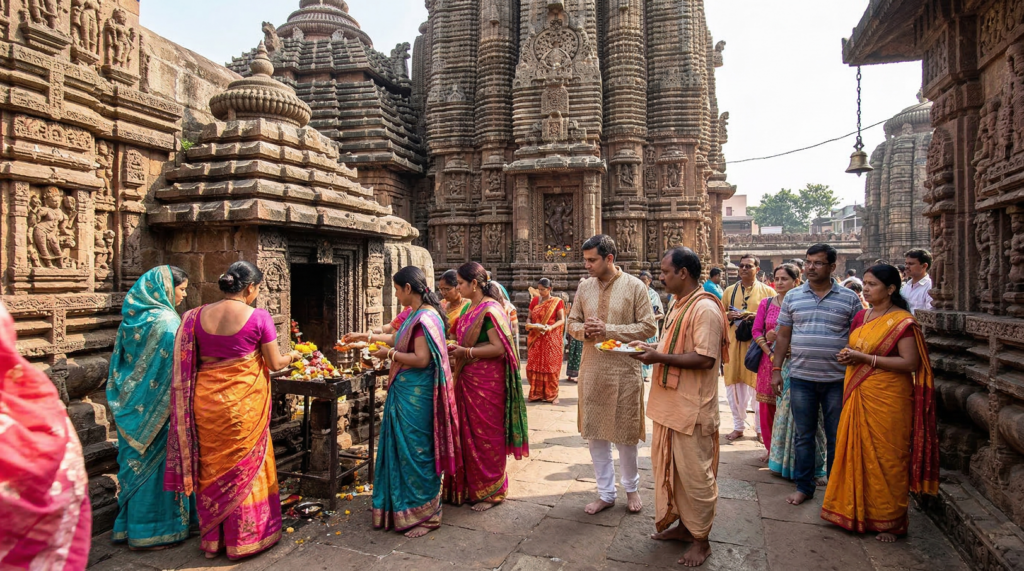
Lingaraj Temple has been a living centre of worship for over a thousand years, making it one of the oldest continuously active temples in eastern India. Here is a closer look at its history, mythology, and religious significance.
Origins and Construction
Construction began under King Jajati Keshari of the Somavamsi dynasty in the 10th century and was completed by King Lalatendu Keshari in the 11th century. The Swayambhu Shivalinga within the sanctum is believed to have been worshipped as early as the 7th century, as the site finds mention in the ancient Brahma Purana.
The Deity: Lord Harihara
Lord Lingaraj is worshipped as Harihara — a sacred fusion of Shiva and Vishnu — making this one of the rare shrines in India where Shaivism and Vaishnavism coexist in a single sanctum. At the Simhadwara (Lion’s Gate), Shiva’s Trishul stands on one side and Vishnu’s Chakra on the other, symbolising this dual devotion.
The Swayambhu Shivalinga
The linga is a naturally formed granite block — 8 feet in diameter and rising 8 inches above the ground. It is bathed daily with water, milk, and bhang, and the deity is offered bhoga eight times a day through offerings including Bala Dhupa, Sakala Dhupa, Madhyahna Dhupa, Sandhya Dhupa, and Bada Singhara.
The Legend of Ekamra Kshetra
According to the Brahma Purana, Lord Shiva told Goddess Parvati that he preferred Bhubaneswar — known as Ekamra Kshetra — over even Kashi. Parvati came disguised as a cowherd woman to explore the city. Two demons, Kritti and Vasa, tried to force her to marry them. She killed both, and Lord Shiva created Bindu Sagar Lake at the spot where she rested, choosing to reside there for eternity.
Darshan Timings and Temple Access
The temple is open every day from 6:00 AM to 12:30 PM and 3:30 PM to 9:00 PM. The midday closure is reserved for the Mahasnana ceremony. Entry is free for all Hindu devotees. Non-Hindus can view the temple from the Curzon Mandap viewing platform near the northern gate. Photography, leather items, and outside food are strictly prohibited inside the premises. The early morning session immediately after the 6:00 AM opening is the most peaceful time for darshan, with fewer crowds and a calm atmosphere.
Architecture: A Masterpiece of the Kalinga Tradition

Lingaraj Temple is the finest example of Kalinga or Deula-style architecture in India, covering approximately 250,000 square feet within a laterite compound wall. The structure is organised into four axially aligned halls in descending height: the Vimana (sanctum tower, 180 feet), the Jagamohana (assembly hall), the Natamandira (festival hall), and the Bhoga Mandapa (hall of offerings). Over 150 smaller shrines dot the courtyard, and the walls are covered in intricate stone carvings of deities, musicians, dancers, and mythological scenes. Historian James Fergusson rated it as one of the finest examples of a purely Hindu temple in India.
Odisha’s historical landscape goes far beyond Lingaraj. Our guide on historical places in Odisha covers significant heritage sites worth pairing with your Bhubaneswar visit.
How to Reach Lingaraj Temple
Bhubaneswar is one of eastern India’s best-connected cities, with direct flights, fast rail links, and good road access from all major metros. The temple sits in the Old Town area and is easily reached by local transport.
How to Reach Lingaraj Temple by Air
Biju Patnaik International Airport is approximately 3 to 4.4 km from the temple — about a 10 to 15 minute journey by taxi or auto-rickshaw. It has direct connections from Mumbai, Delhi, Kolkata, Hyderabad, and Bangalore.
How to Reach Lingaraj Temple by Train
Bhubaneswar Railway Station is 4 to 5 km from the temple and is well connected to all major cities. Auto-rickshaws, taxis, and local buses are readily available from the station.
How to Reach Lingaraj Temple by Road
Bhubaneswar is connected to Puri (60 km), Cuttack (30 km), and Konark (65 km) by well-maintained highways. Within the city, the temple is accessible by auto-rickshaw, taxi, and the Mo Bus city service (Route 32 from Baramunda ISBT).
Nearby Places to Visit
Bhubaneswar and the surrounding region offer a strong mix of spiritual, historical, and natural destinations that pair well with a Lingaraj Temple visit. Here are the most worthwhile stops to add to your itinerary.
Bindu Sagar Lake: Located immediately north of the temple, this sacred lake is the focal point of Chandan Yatra and Kartik Purnima and is surrounded by smaller shrines and ghats.
Mukteshwar Temple: A 10th-century Shiva temple about 1 km away, known for its intricately carved torana (gateway arch) — one of the finest examples of early Kalinga sculptural work.
Rajarani Temple: About 1.5 km from Lingaraj, notable for its warm red and yellow sandstone exterior and detailed carvings of damsels, elephants, and celestial figures. Open to visitors of all faiths.
Udayagiri and Khandagiri Caves: Rock-cut Jain caves on the outskirts of Bhubaneswar dating to the 2nd century BCE, with some of the oldest inscriptions in eastern India.
Konark Sun Temple: A UNESCO World Heritage Site approximately 65 km away. Our guide on the best time to visit Konark Sun Temple will help you plan that leg of your Odisha itinerary.
Dhauli Peace Pagoda: About 8 km from Bhubaneswar, this is the site where Emperor Ashoka renounced violence after the Kalinga War and embraced Buddhism.
Odisha also has some mysterious and atmospheric corners beyond the main circuit. Our guide on haunted places in Odisha explores lesser-known destinations worth considering if you are extending your trip.
Essential Tips for Visiting Lingaraj Temple
- Entry is restricted to Hindus. Non-Hindu visitors should use the Curzon Mandap viewing platform at the northern gate.
- The morning session from 6:00 AM to 8:00 AM is the most peaceful time for darshan.
- The temple closes between 12:30 PM and 3:30 PM for the Mahasnana ceremony. Plan around this break.
- Photography is strictly prohibited inside the temple and inner courtyard.
- Wear modest, traditional attire — saree, salwar kameez, kurta-pyjama, or dhoti.
- Leather items are not permitted inside. Leave them secured before entering.
- Avoid touts near the gate. Use only the services of official temple priests.
- On Maha Shivaratri and Ashokashtami, expect very large crowds. Arrive well before the temple opens.
- Plan for 1 to 2 hours at Lingaraj and combine with Mukteshwar Temple, Rajarani Temple, and Bindu Sagar on the same day.
Conclusion
Lingaraj Temple is a living shrine that has welcomed devotees without interruption for over a thousand years. Whether you come for darshan, for the grandeur of Kalinga stonework, or for the extraordinary energy of Maha Shivaratri, it is an experience that stays with you long after you leave.
October to March is the best time to visit Lingaraj Temple for comfortable weather and a full festival experience, with February to April being the most spiritually charged window of all. Plan early, dress modestly, and give yourself the time to absorb everything this ancient shrine has to offer.

At Frenzy Holidays, we help you plan pilgrimage and heritage travel across Odisha and beyond. Reach out to us at [email protected], call us at 074004 53140, or visit us at Frenzy Holidays, Haware Centurion, S07/34, Nerul East, Sector 19A, Nerul, Navi Mumbai, Maharashtra 400706, and we will take care of every detail of your yatra.
Best Time to Visit Lingaraj Temple FAQs
What is the best time to visit Lingaraj Temple?
October to March is the best season for a comfortable visit, with pleasant temperatures between 15°C and 30°C. February to April is the most festival-rich window.
What are the darshan timings at Lingaraj Temple?
The temple is open from 6:00 AM to 12:30 PM and again from 3:30 PM to 9:00 PM daily. On Maha Shivaratri, timings extend from 3:30 AM to 11:00 PM.
Is entry to Lingaraj Temple free?
Yes, entry is completely free for all Hindu devotees.
Can non-Hindus visit Lingaraj Temple?
Non-Hindus are not permitted inside the main complex. The Curzon Mandap viewing platform near the northern gate allows them to see the temple exterior.
Which is the most important festival at Lingaraj Temple?
Maha Shivaratri is the most significant, drawing over two lakh devotees in a single day. Ashokashtami, Chandan Yatra, and Kartik Purnima are the other major festivals.
How far is Lingaraj Temple from Bhubaneswar Airport?
Biju Patnaik International Airport is approximately 3 to 4.4 km away, about a 10 to 15 minute journey by taxi or auto-rickshaw.
How far is Konark from Lingaraj Temple?
Konark Sun Temple is approximately 65 km from Lingaraj Temple, about 1.5 to 2 hours by road.
Is photography allowed at Lingaraj Temple?
Photography is strictly prohibited inside the temple premises, including the sanctum and inner courtyard.
What should I wear to visit Lingaraj Temple?
Modest, traditional attire is required — sarees, salwar kameez, kurta-pyjama, and dhotis are all appropriate.
What are the places to visit near Lingaraj Temple?
Bindu Sagar Lake, Mukteshwar Temple, Rajarani Temple, Udayagiri and Khandagiri Caves, Dhauli Peace Pagoda, and Konark Sun Temple are all within easy reach and form a natural circuit for visitors to Bhubaneswar.
