
The best time to visit Khajjiar is from April to June, when the weather is pleasantly cool, the meadows are at their greenest, and all outdoor activities are fully accessible. December to February is ideal for snow lovers, while July to September offers a lush monsoon experience. Khajjiar is a year-round destination — your best time depends on the experience you are looking for.
Sitting at an elevation of 1,920 metres in the Chamba district of Himachal Pradesh, Khajjiar is one of the most scenic hill stations in India. Often called the Mini Switzerland of India — a title officially recognised by the Swiss Ambassador in 1992 — this small meadow town is defined by its vast circular grassland, a serene lake at its centre, dense deodar and fir forests on all sides, and snow-capped Himalayan peaks in the backdrop. Whether you come for the adventure activities, the wildlife, or simply the quiet of the mountains, understanding the best time to visit Khajjiar helps you align your trip with the experience that suits you most.
Confused where to go for quick escape? Let us plan it for you.
Grab the Best DealTable of Contents
Quick Reference: Khajjiar Visit Planner
Here is a snapshot of everything you need to know before planning your trip.
| Detail | Information |
|---|---|
| Location | Chamba District, Himachal Pradesh |
| Elevation | 1,920 metres (6,300 feet) |
| Distance from Dalhousie | Approximately 24 km |
| Distance from Chamba | Approximately 24 km |
| Distance from Pathankot | Approximately 118 km |
| Nearest Airport | Gaggal Airport, Kangra (~120 km) |
| Nearest Railway Station | Pathankot Junction (~118 km) |
| Best Season | April to June (overall); December to February (snow) |
| Peak Season | April to June |
| Average Summer Temperature | 12°C to 25°C |
| Average Winter Temperature | -5°C to 10°C |
| Key Activities | Zorbing, horse riding, trekking, paragliding, wildlife safari |
Best Time to Visit Khajjiar
Khajjiar is accessible and beautiful in every season, but the experience shifts significantly with the weather. The best time to visit Khajjiar is between April and June for the most comfortable and activity-rich visit. However, each season has a distinct appeal, and the right time to go depends on what you want from your trip.
April to June: Best Season Overall
April to June is the peak season in Khajjiar and for good reason. Temperatures stay between 12°C and 25°C, the meadow is at its lushest green, wildflowers bloom across the grassland, and the skies are clear enough for stunning views of the Dhauladhar and Pir Panjal ranges. All adventure activities — zorbing, horse riding, paragliding, and trekking — are available and at their best. The Khajjiar to Dainkund trek is particularly rewarding in this season. Since this is peak tourist season, book accommodation in advance as hotels fill up quickly, especially over weekends.
December to February: Snow Season
Khajjiar transforms into a snow-covered wonderland from December through February. Temperatures can drop to -5°C or below, and the entire meadow, the surrounding forests, and the lake freeze over in a quiet, beautiful stillness. This is the most romantic season for couples and the most photogenic for photographers. It is also the most affordable time to visit, as tourist numbers are lower and hotels offer better rates. Pack heavy woolens, thermal wear, and waterproof footwear. Road conditions can occasionally be affected by heavy snowfall — check conditions before travelling from Pathankot or Dalhousie.
July to September: Monsoon Season
The monsoon months turn Khajjiar into a deeply green, mist-covered landscape that is quite unlike any other season. The meadow is richly saturated, streams flow through the forest, and the air is cool and clean. Accommodation is budget-friendly during this period. However, moderate to heavy rainfall can make some outdoor activities unavailable, and the roads from Pathankot can have occasional waterlogging or landslide risks. If you enjoy misty hill landscapes and do not mind the rain, the monsoon offers a serene and uncrowded Khajjiar experience.
October to November: Pleasant Shoulder Season
October and November bring a post-monsoon clarity to Khajjiar. The greenery is still rich, the skies are clear, the air has a sharp crispness to it, and crowds are thinner than the summer peak. Temperatures range between 10°C and 20°C. This is a good shoulder season for those who want comfortable weather without peak-season crowds. Adventure activities are available and the views of the mountain ranges on clear days are exceptional.
About Khajjiar: What Makes It Special
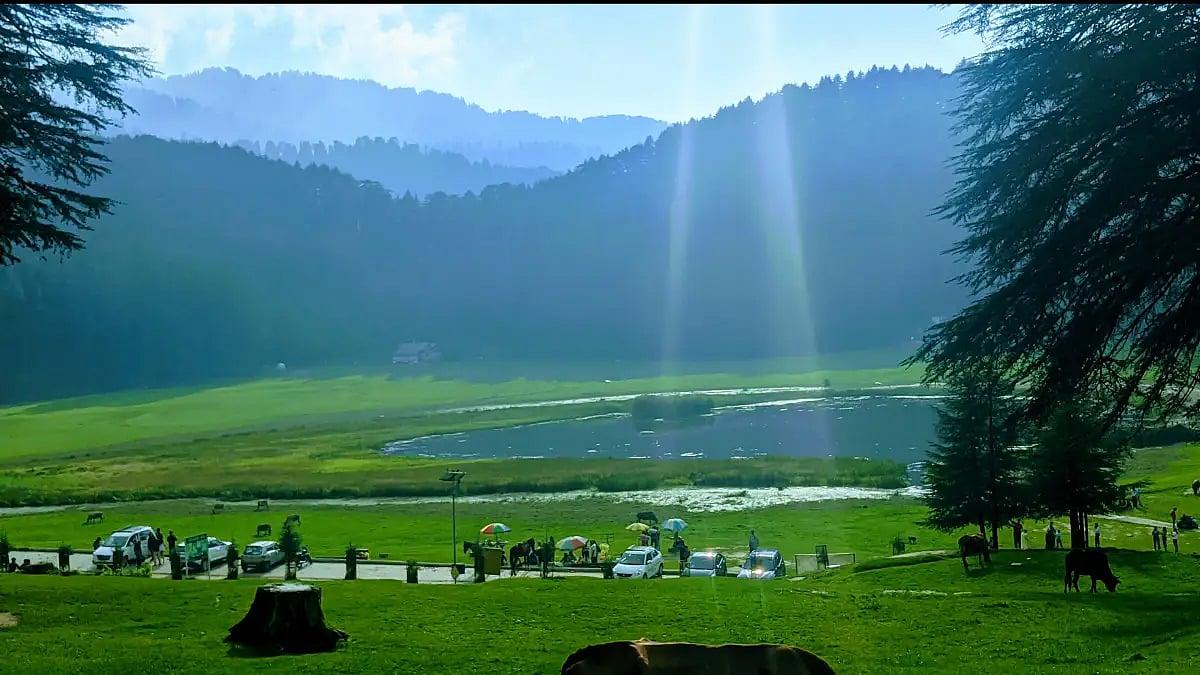
Khajjiar is a rare combination of a saucer-shaped meadow, a natural lake, dense forests, and Himalayan views — all within a compact and easily walkable area. The circular grassland at the centre of Khajjiar is its defining feature: a soft green carpet ringed by towering deodar trees, with the small Khajjiar Lake sitting quietly at the middle. The meadow is used for zorbing, horse riding, and picnics, and serves as the natural gathering point for all visitors.
Khajji Nag Temple
Situated on the edge of the Khajjiar Lake, the Khajji Nag Temple is a 12th-century wooden shrine built by King Prithvi Singh of Chamba. Dedicated to Khajji Nag, the serpent deity, the temple features a golden dome and spire, intricate wood carvings on the ceiling and pillars, and images of the five Pandavas crafted from wooden threads in the corners of the mandapa. Idols of Lord Shiva and Goddess Hadimba are also enshrined within the complex. The temple blends Pahari and Mughal architectural influences and is one of the most historically significant sites in the Chamba district.
Kalatop Wildlife Sanctuary
Located between Khajjiar and Dalhousie, the Kalatop Wildlife Sanctuary spreads across approximately 30 square kilometres of dense deodar and fir forest. Founded in 1958, it is home to leopards, Himalayan black bears, barking deer, serow, langur, and over 117 species of birds including the Himalayan Monal, Koklas pheasant, and Eurasian Jay. The sanctuary has well-marked trekking trails and is one of the best wildlife and nature-walk destinations in Himachal Pradesh. Entry permit costs ₹250 and timings are 7:00 AM to 6:00 PM.
Activities in Khajjiar
- Zorbing: Rolling downhill inside a giant transparent plastic ball on the meadow slope — the most popular activity in Khajjiar
- Horse riding: Guided rides across the meadow and forest trails
- Trekking: The Khajjiar to Dainkund trek (approximately 3.5 km) is beginner-friendly and ends at the Pholani Devi Temple with panoramic views
- Paragliding: Soft paragliding available during the summer months
- Wildlife safari: Nature walks and guided wildlife trails through Kalatop Sanctuary
How to Reach Khajjiar
Khajjiar is well connected by road from Pathankot, Dalhousie, and Chamba. There is no direct train or flight to Khajjiar, so road travel is the primary option for the final leg of the journey.
By Air
Gaggal Airport in Kangra is the nearest airport, approximately 120 km from Khajjiar. It has regular connections from Delhi and Mumbai. From Gaggal, hire a private taxi to Khajjiar directly, which takes approximately 3 to 3.5 hours. For Himachal group travel packages from Mumbai, our Himachal group tour packages from Mumbai include pickup and travel arrangements that take the hassle out of the journey.
By Train
Pathankot Junction is the nearest major railhead, approximately 118 km from Khajjiar. It is well connected to Delhi, Mumbai, Amritsar, and Jammu. From Pathankot, hire a private taxi or take a bus via Dalhousie to Khajjiar. The road journey from Pathankot to Khajjiar takes approximately 3 to 3.5 hours.
By Road
Khajjiar is 24 km from both Dalhousie and Chamba, and approximately 118 km from Pathankot. The roads between Dalhousie and Khajjiar are scenic and well-maintained in summer and autumn. In winter, check road conditions before setting out, as snowfall can occasionally affect the Dalhousie to Khajjiar stretch.
Nearby Places to Visit
Khajjiar sits at the heart of the Chamba district, one of the most historically and naturally rich regions of Himachal Pradesh. Several worthwhile destinations are within easy reach and pair naturally with a Khajjiar visit.
Dalhousie: The closest hill station to Khajjiar, approximately 24 km away, Dalhousie is a colonial-era retreat known for its British-era churches, Bakrota Hills, and the Dainkund Peak. It makes an excellent base for a Khajjiar day trip or a natural pairing for a 2 to 3 day Himachal itinerary.
Chamba: Located approximately 24 km from Khajjiar, Chamba is one of the oldest towns in Himachal Pradesh with a rich collection of ancient temples, the Bhuri Singh Museum, and the Chaugan — a large open ground that hosts the famous Minjar Fair every August.
Palampur: A tea-growing town in the Kangra Valley, Palampur is known for its lush tea gardens, views of the Dhauladhar range, and proximity to Bir Billing — one of the best paragliding destinations in Asia. Our guide on the best places to visit in Palampur covers the full picture for planning that extension.
Spiti Valley: For travellers looking to push deeper into the Himachal mountains, Spiti Valley is one of the most dramatic high-altitude landscapes in India. Our guide on places to visit in Spiti Valley will help you plan that adventure. If Khajjiar and Spiti feel like two different Himachals — they are, and both are worth experiencing.
For those who love mountain destinations beyond Himachal, our guide on best places to visit in mountains covers some of the finest high-altitude escapes across India.
Essential Tips for Visiting Khajjiar
- Book accommodation in advance during April to June, especially over long weekends and school holidays when Khajjiar fills up quickly.
- Carry warm layers even in summer — evenings and mornings are consistently cool at this altitude.
- In winter, pack heavy woolens, thermals, waterproof boots, and gloves. Sub-zero temperatures are common in January.
- Road conditions between Dalhousie and Khajjiar can be affected by snowfall in winter. Always check before travelling.
- The meadow can get muddy during and immediately after the monsoon months — wear sturdy, waterproof footwear.
- Adventure activities like zorbing and horse riding are priced per ride on the meadow. Negotiate rates before boarding.
- The Kalatop Wildlife Sanctuary requires an entry permit of ₹250. Timings are 7:00 AM to 6:00 PM. A guide is recommended, especially for longer trails.
- Mobile connectivity in Khajjiar village is patchy for some networks. Download offline maps of the Chamba district before arriving.
- Most stays and restaurants in Khajjiar are small, family-run establishments. For a wider range of accommodation, base yourself in Dalhousie and make a day trip.
Conclusion
Khajjiar is one of those rare hill destinations that rewards you regardless of when you visit — the meadow is green in summer, snow-white in winter, and mist-draped in the monsoon. Each season offers a genuinely different experience of the same beautiful landscape.
April to June is the best time to visit Khajjiar for most travellers, combining comfortable weather, lush scenery, and the full range of activities. For snow, December to February is magical. For quiet and greenery on a budget, the monsoon months and the October to November shoulder season are excellent choices.

At Frenzy Holidays, we help you plan the perfect Himachal Pradesh trip, whether it is a quick Khajjiar getaway or a full Himachal circuit. Reach out to us at [email protected], call us at 074004 53140, or visit us at Frenzy Holidays, Haware Centurion, S07/34, Nerul East, Sector 19A, Nerul, Navi Mumbai, Maharashtra 400706, and we will take care of every detail.
Best Time to Visit Khajjiar FAQs
What is the best time to visit Khajjiar?
April to June is the best time to visit Khajjiar for pleasant weather and all outdoor activities. December to February is ideal for snow experiences, while October to November is a quieter, comfortable shoulder season.
Does it snow in Khajjiar?
Yes. Khajjiar receives snowfall from December to February, with January being the coldest month. Temperatures can drop to -5°C or below during heavy snowfall periods.
How far is Khajjiar from Dalhousie?
Khajjiar is approximately 24 km from Dalhousie, about a 45 to 60 minute drive by road.
How far is Khajjiar from Pathankot?
Pathankot is approximately 118 km from Khajjiar, about a 3 to 3.5 hour drive by road.
What activities are available in Khajjiar?
Zorbing, horse riding, trekking, soft paragliding, and wildlife safaris at Kalatop Sanctuary are the main activities. The Khajjiar to Dainkund trek is a popular option for beginners.
Is Khajjiar accessible in winter?
Yes, Khajjiar is accessible in winter, though heavy snowfall can occasionally affect the Dalhousie to Khajjiar road. Check road conditions before travelling between December and February.
Is Khajjiar safe to visit during monsoon?
Khajjiar is generally safe during the monsoon, but heavy rains can cause road disruptions between Pathankot and Dalhousie. Monitor weather forecasts and road conditions before travelling in July to September.
How many days are enough for Khajjiar?
One to two days are sufficient to explore Khajjiar fully, including the meadow, Khajji Nag Temple, and Kalatop Wildlife Sanctuary. Combine with Dalhousie and Chamba for a 3 to 4 day Chamba district trip.
What is the nearest airport to Khajjiar?
Gaggal Airport in Kangra is the nearest airport, approximately 120 km from Khajjiar. Pathankot Junction is the nearest railway station at approximately 118 km.
Why is Khajjiar called the Mini Switzerland of India?
Khajjiar earned this title in 1992 when the Swiss Ambassador to India officially recognised its striking resemblance to the Swiss landscape — a circular green meadow, a central lake, dense forests, and snow-capped mountain views.
