
The best time to visit Nagaland is between October and March, when the weather is cool, pleasant, and perfect for exploring the state’s tribal villages, trekking trails, and cultural festivals. December is the most celebrated month, home to the iconic Hornbill Festival – a 10-day showcase of all 16 Naga tribes held at Kisama Heritage Village near Kohima.
Tucked into the far northeastern corner of India, Nagaland is a state unlike any other- a land of misty hill ranges, dense forests, living tribal traditions, and some of the most vibrant festivals in the subcontinent. Known as the Land of Festivals, Nagaland is home to 16 major tribes, each with its own distinct customs, attire, music, and agricultural celebrations. For travellers seeking an experience that goes far beyond the ordinary, this is one of India’s most rewarding destinations. Understanding the best time to visit Nagaland ensures you plan around the right weather, the right festivals, and the right activities to get the most out of this extraordinary state.
Confused where to go for quick escape? Let us plan it for you.
Grab the Best DealTable of Contents
Best Time to Visit Nagaland: Quick Overview
Here is a handy snapshot of everything you need to know before planning your trip.
| Detail | Information |
|---|---|
| State Capital | Kohima |
| Major Entry Point | Dimapur (nearest airport and railway station) |
| Distance: Dimapur to Kohima | Approximately 74 km (2 to 3 hours by road) |
| Distance: Guwahati to Dimapur | Approximately 270 km (5 to 6 hours by train) |
| Best Season | October to March |
| Peak Month | December (Hornbill Festival) |
| Key Festivals | Hornbill Festival, Sekrenyi, Moatsu, Aoling Monyu |
| Winter Temperature | 4°C to 24°C |
| Summer Temperature | 16°C to 31°C |
| Inner Line Permit | Required for all non-Nagaland residents |
| Nearest Airport | Dimapur Airport |
| Nearest Railway Station | Dimapur Railway Station |
You can also explore our affordable Sikkim Tour Packages designed for Budget Travellers.
Best Time to Visit Nagaland
The best time to visit Nagaland is from October to March. The state experiences a temperate climate due to its hilly terrain, but the winter months bring the most comfortable conditions for travel, trekking, and cultural exploration. This period also coincides with the state’s most celebrated festivals, making it the most rewarding window for first-time and returning visitors alike.
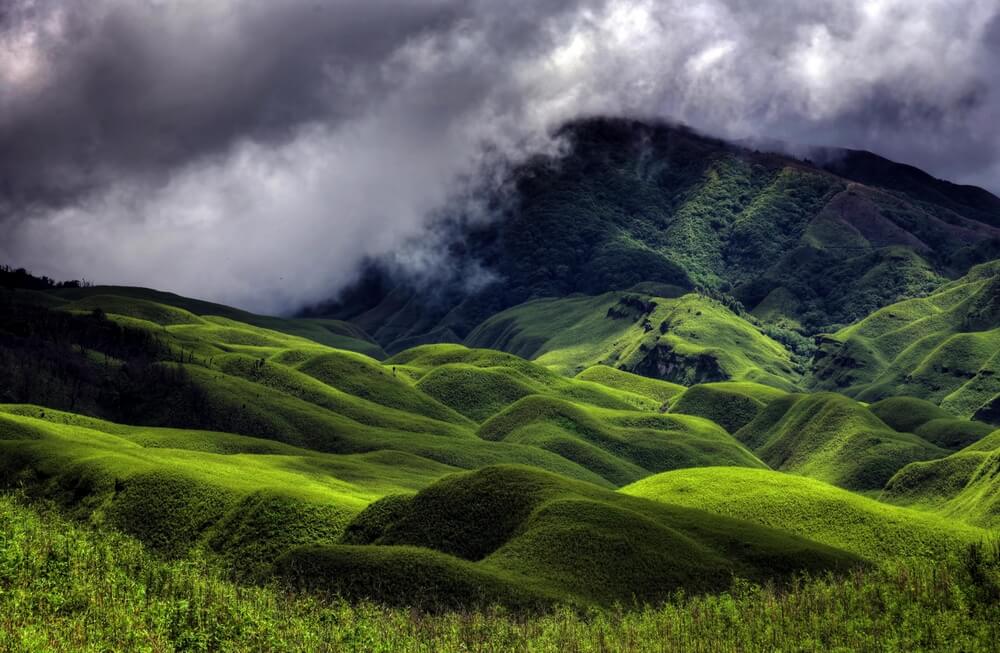
October to March: Best Time to Visit Nagaland Overall
Temperatures during winter in Nagaland range between 4°C and 24°C, with cool days and crisp nights. Humidity drops significantly, making outdoor activities, village walks, and mountain treks comfortable. The roads are at their best during this period, with no risk of landslides or monsoon-related disruptions. October and November are particularly good months for trekking- the post-monsoon landscape is lush and green, skies are clear, and trails are in excellent condition.
For those planning a broader Northeast India trip, Nagaland pairs well with Assam’s wildlife circuit. Our guide on places to visit in Kaziranga covers the famous national park in detail, and the two destinations can be combined into a single itinerary from Guwahati.
December: Hornbill Festival and Peak Tourism
December is the single most popular month to visit Nagaland, and for good reason. The Hornbill Festival, held from December 1 to 10 every year at Kisama Heritage Village- approximately 12 km from Kohima- is one of India’s greatest cultural spectacles. Organised by the Nagaland Government, it brings all 16 Naga tribes together under one roof for 10 days of traditional dance, music, folk songs, tribal sports, food fairs, arts and crafts, and indigenous games. Entry tickets are available at the gate for approximately ₹20 to ₹30 per day. The festival is also paired with an International Rock Concert at Indira Gandhi Stadium in the evenings, making it an experience that appeals to all kinds of travellers.
Temperatures in December drop to between 4°C and 15°C during the day, with nights dipping close to 0°C at higher altitudes. Pack warm layers. Accommodation in Kohima and near Kisama fills up fast — book at least 4 to 6 weeks in advance if you are visiting during the Hornbill Festival.
March to May: Spring and Tribal Festivals
Spring is an excellent secondary season for visiting Nagaland. Temperatures rise gradually from March to May, ranging between 16°C and 31°C, and the hillsides come alive with flowering rhododendrons. This is also the season of several important tribal festivals. Sekrenyi in February and March is the purification festival of the Angami tribe, one of the most spiritually significant celebrations in Nagaland. Moatsu in May is celebrated by the Ao tribe as a harvest thanksgiving festival, featuring feasting, folk songs, and community dances. Aoling Monyu in April is the spring festival of the Konyak tribe, one of the most colourful and widely attended tribal celebrations of the season.
Crowds are thinner in spring compared to December, and accommodation is more readily available. This season is ideal for those who want an intimate tribal experience rather than the large-scale energy of the Hornbill Festival.
June to September: Monsoon- Rich but Challenging
The monsoon season in Nagaland runs from June to September, with July and August receiving the heaviest rainfall — up to 381 mm in July alone. The landscape becomes extraordinarily lush, and the hills take on a deep green that is unlike anything seen in the dry months. However, landslides are a real risk on mountain roads, and several routes in the state can be disrupted by heavy rains. Sightseeing is limited, and many trekking routes become difficult or unsafe.
The monsoon is best suited to experienced travellers who are comfortable with uncertainty and prioritise landscapes and solitude over accessibility and festivals. Budget travellers benefit from lower hotel rates and fewer crowds during this period.
About Nagaland: Why It Is Unlike Anywhere Else
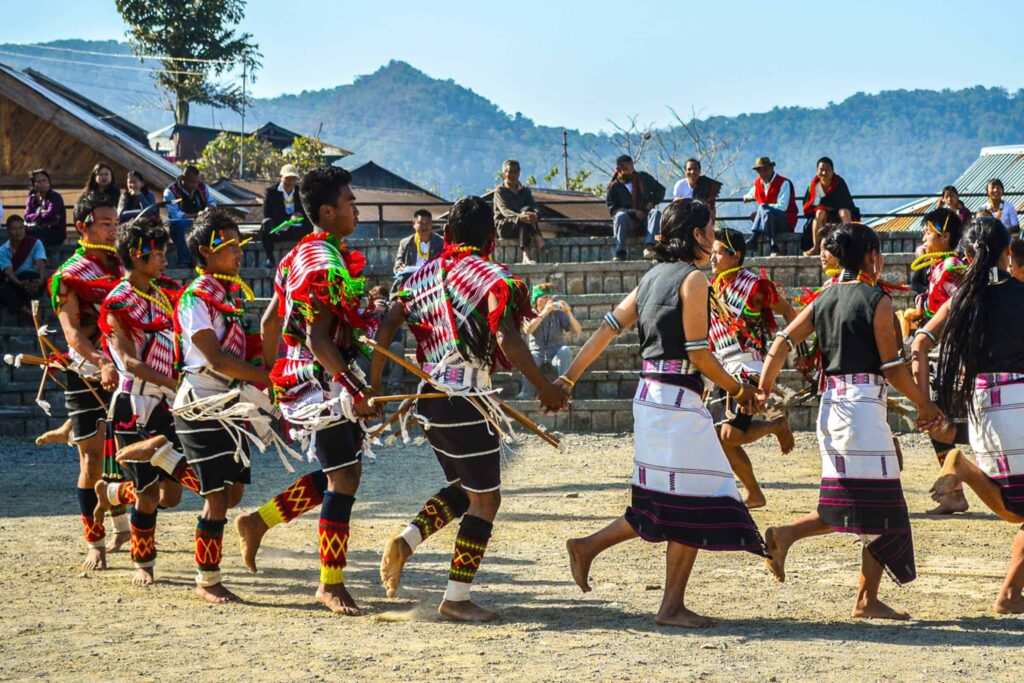
Nagaland is home to 16 recognised tribes – including the Angami, Ao, Konyak, Lotha, Sumi, Chakhesang, and Zeliang — each with distinct traditions, attire, architecture, and festivals. Over 90 percent of the population is Christian, giving the state a unique cultural identity that blends deep tribal heritage with a strong community-based Christian faith. December in particular sees Christmas celebrations layered on top of the Hornbill Festival, filling Kohima and surrounding villages with carolling, decorated churches, and festive markets.
The state capital Kohima sits at an altitude of approximately 1,444 metres and is famous for the Battle of Kohima in 1944 — a turning point in World War II in Southeast Asia. The Kohima War Cemetery, maintained by the Commonwealth War Graves Commission, is one of the most moving memorials in Northeast India and a must-visit for history travellers.
Nagaland’s natural landscapes are equally remarkable. The Dzukou Valley, sitting at approximately 2,438 metres on the Nagaland-Manipur border, is one of the most beautiful trekking destinations in Northeast India — known for its seasonal wildflowers, rolling meadows, and the rare Dzukou lily that blooms between December and January. Our detailed guide on the best time to visit Dzukou Valley covers the trek in full.
Inner Line Permit: Essential for All Visitors
All Indian citizens who are not residents of Nagaland require an Inner Line Permit (ILP) to enter the state. The ILP can be obtained from:
- Nagaland House offices in New Delhi, Kolkata, Guwahati, and Shillong
- The Deputy Commissioner’s office in Dimapur (on arrival)
- Online through the Nagaland government’s ILP portal
Foreign nationals must register at the Foreigners Registration Office (FRO) in Dimapur within 24 hours of arrival. Carry multiple photocopies of your permit at all times as checkpoints are common at state entry points.
How to Reach Nagaland
Nagaland does not have its own commercial airport or railway station at the capital level. All major access routes go through Dimapur, the state’s commercial hub and main gateway.
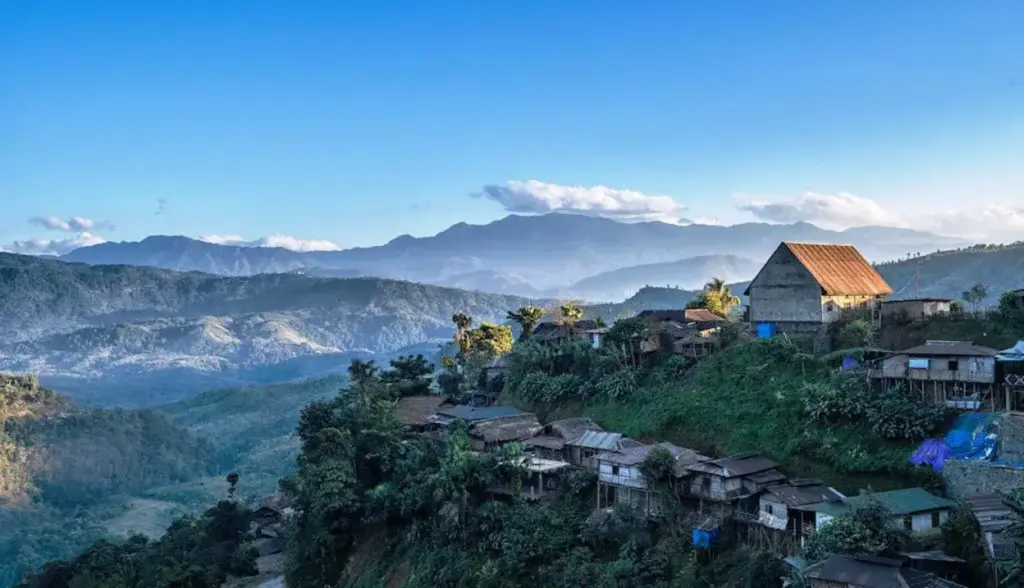
By Air
Dimapur Airport has regular flight connections from Kolkata, Guwahati, Delhi, and Imphal. From Dimapur, Kohima is approximately 74 km away — a 2 to 3 hour drive by private taxi or shared cab through scenic mountain roads. Most travellers also fly into Guwahati (Lokpriya Gopinath Bordoloi International Airport) and proceed to Dimapur by train.
By Train
Dimapur Railway Station is the only major railhead in Nagaland, with connections to Guwahati, Kolkata, and other major cities. The Guwahati to Dimapur journey takes approximately 5 to 6 hours by train and is one of the most scenic rail routes in Northeast India. From Dimapur, taxis and shared cabs run regularly to Kohima.
By Road
Nagaland is connected to Assam, Manipur, Arunachal Pradesh, and Meghalaya by a network of national and state highways. NH29 connects Dimapur to Kohima. State transport buses and private buses operate from Guwahati to Dimapur and Kohima. Road travel through Nagaland is scenic but requires patience, as mountain roads can be narrow and winding.
Nearby Places to Visit
Nagaland sits at the heart of Northeast India’s most rewarding travel corridor, with exceptional destinations within easy reach across the region.
Kohima War Cemetery: Located in the heart of Kohima city, this beautifully maintained cemetery is the resting place of Allied soldiers who fell in the Battle of Kohima in 1944. The inscription on the memorial – among the most quoted in military history – makes it one of the most profound heritage sites in India.
Khonoma Village: Approximately 20 km from Kohima, Khonoma is widely regarded as India’s first green village and is a model of community-based conservation. The village is a living example of traditional Angami culture and offers guided walks through its terraced fields and traditional morung (communal halls).
Japfu Peak: At approximately 3,048 metres, Japfu Peak near Kohima is the second highest peak in Nagaland and a rewarding day trek with panoramic views of the surrounding valleys and, on clear days, as far as the Brahmaputra plains.
Mokokchung: The cultural heart of the Ao tribe, Mokokchung is one of Nagaland’s most visited towns outside Kohima. Known for its vibrant music scene, traditional weaving, and the Moatsu Festival in May, it offers a deeper look at tribal life away from the Hornbill circuit.
Mon District: Home to the Konyak tribe — historically known as headhunters — Mon is one of the most ethnographically fascinating districts in India. The villages of Longwa and Shangnyu offer encounters with the last of the Konyak chiefs and a window into a way of life rapidly disappearing.
Nagaland also makes a natural starting point for exploring Assam’s heritage towns. Our guides on places to visit in Tezpur and places to visit in Kokrajhar cover two of Assam’s most rewarding destinations, both easily accessible from Dimapur.
Essential Tips for Visiting Nagaland
- Obtain your Inner Line Permit before travelling. Carry physical copies at all times — digital copies may not be accepted at all checkpoints.
- Book accommodation in Kohima and near Kisama at least 4 to 6 weeks in advance for the Hornbill Festival. Options fill up extremely fast in December.
- The Hornbill Festival entry ticket costs approximately ₹20 to ₹30 per day, with additional charges for cameras.
- Dress modestly and respectfully when visiting tribal villages and churches. Always ask permission before photographing locals or their homes.
- Carry sufficient cash in Kohima and beyond. ATMs are available in Dimapur and Kohima but rare in smaller towns and villages.
- Mobile connectivity is good in Dimapur and Kohima but can be patchy in Dzukou Valley and remote districts. Download offline maps before setting out.
- Naga cuisine features smoked meats, fermented bamboo shoots, and rice-based preparations. Most local eateries serve both vegetarian and non-vegetarian food, but options for strict vegetarians can be limited in remote areas.
- Temperatures in higher altitude areas drop close to 0°C in December and January. Pack warm layers, especially if combining with a Dzukou Valley trek.
- Respect local customs around Sunday observance — Nagaland has a predominantly Christian population and many shops and services operate on reduced hours on Sundays.
Also you can check out our blog about the Best Time to Visit Dzukou Valley so that it can help you find the best time for your next trip.
Conclusion
Nagaland rewards those who seek it out with an experience that is genuinely one of a kind — living tribal culture, extraordinary festivals, pristine trekking landscapes, and a warmth of hospitality that is hard to find anywhere else in India. Whether you come for the Hornbill Festival in December, the spring wildflowers of Dzukou Valley, or the intimate tribal ceremonies of the Ao and Konyak tribes, the state leaves a lasting impression.
October to March is the best time to visit Nagaland for comfortable weather and the richest cultural experiences, with December being the most unmissable single month for first-time visitors. Plan early, obtain your ILP in advance, and give yourself at least 5 to 7 days to do justice to everything this remarkable state has to offer.

At Frenzy Holidays, we help you plan immersive travel experiences across Northeast India and beyond. Reach out to us at [email protected], call us at 074004 53140, or visit us at Frenzy Holidays, Haware Centurion, S07/34, Nerul East, Sector 19A, Nerul, Navi Mumbai, Maharashtra 400706, and we will take care of every detail of your Nagaland journey.
Best Time to Visit Nagaland : FAQs
What is the best time to visit Nagaland?
October to March is the Best Time to Visit Nagaland, with cool temperatures between 4°C and 24°C. December is the peak month due to the Hornbill Festival.
What is the Best Time to Visit Nagaland for Hornbill Festival?
It is Nagaland’s biggest cultural festival, held from December 1 to 10 at Kisama Heritage Village near Kohima, showcasing all 16 Naga tribes also this month comes under Best Time to Visit Nagaland.
Do I need a permit to visit Nagaland?
Yes. All non-Nagaland residents require an Inner Line Permit, available from Nagaland House offices in Delhi, Kolkata, Guwahati, and Shillong, or on arrival at Dimapur.
How do I reach Nagaland?
Fly or take a train to Guwahati, then connect to Dimapur by train (5 to 6 hours). From Dimapur, Kohima is approximately 74 km by road.
What is the weather like in Nagaland in December?
Temperatures range between 4°C and 15°C during the day, with nights near 0°C at higher altitudes. Pack warm layers.
Which tribal festivals can I attend in Nagaland?
Key festivals include Hornbill (December), Sekrenyi (February to March), Aoling Monyu (April), and Moatsu (May).
Is Nagaland safe to visit?
Yes, Nagaland is safe for tourists. The locals are warm and hospitable. Exercise standard caution on mountain roads during the monsoon.
What should I pack for a Nagaland trip?
Warm layers, trekking shoes, rain gear, modest clothing for village visits, and sufficient cash for remote areas.
Can I trek to Dzukou Valley during the Hornbill Festival?
Yes. Dzukou Valley is about 20 km from Kohima and is easily combined with a Hornbill Festival visit. The trek takes 2 to 3 days.
What are the best places to visit in Nagaland beyond Kohima?
Khonoma Village, Mokokchung, Mon District, Japfu Peak, and Dzukou Valley are all excellent destinations worth adding to your itinerary.
