
The best time to visit Amber Fort Jaipur is October to March, when Jaipur’s winter weather makes walking the open courtyards, climbing the ramparts, and exploring the Sheesh Mahal genuinely comfortable. Every other season has something to offer, but the winter months give you the best combination of weather, photography light, and cultural events.
This guide covers every season at Amber Fort Jaipur, the ideal time of day to visit, entry fees, the light and sound show, what to see inside, and practical tips to make the most of your trip in 2026.
Table of Contents
Quick Overview: Best Time to Visit Amber Fort Jaipur
Two lines cannot do justice to a fort of this scale, but the table below gives you the fastest read on each season before the detailed breakdowns follow.
| Season | Months | Temperature | Verdict |
| Winter | October to March | 8°C to 25°C | Best time to visit Amber Fort Jaipur |
| Summer | April to June | 30°C to 45°C | Manageable only at 8 AM to 10 AM |
| Monsoon | July to September | 25°C to 35°C | Scenic but humid; some access issues |
| Post-Monsoon | October to November | 18°C to 30°C | Excellent; green hills, fewer crowds |
Why Visit Amber Fort Jaipur
Amber Fort is not just another heritage site on a Rajasthan itinerary. It is one of the finest examples of Rajput architecture in India, a UNESCO World Heritage Site, and a fort that rewards time and attention in a way that most Indian monuments simply do not.
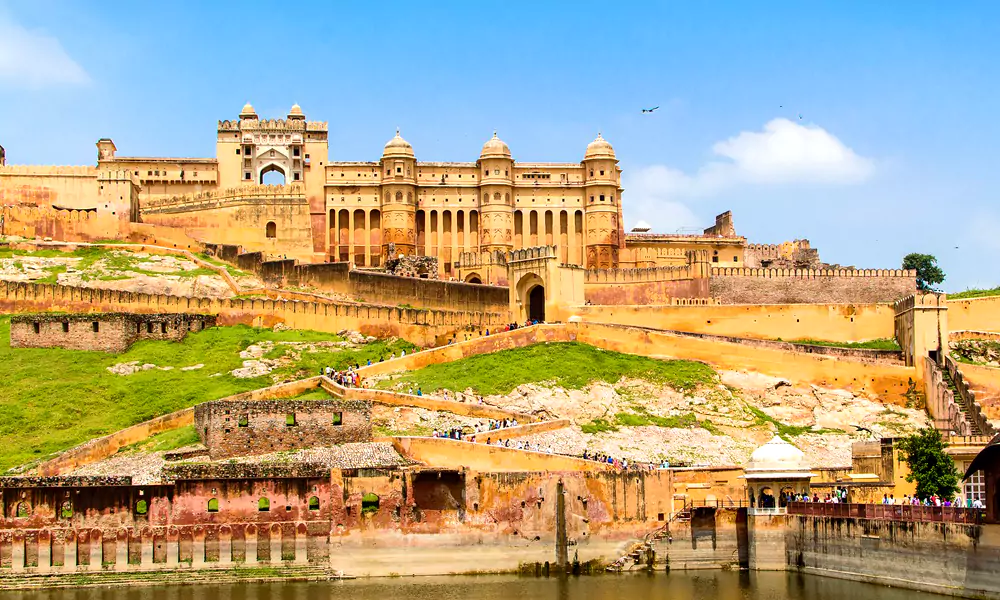
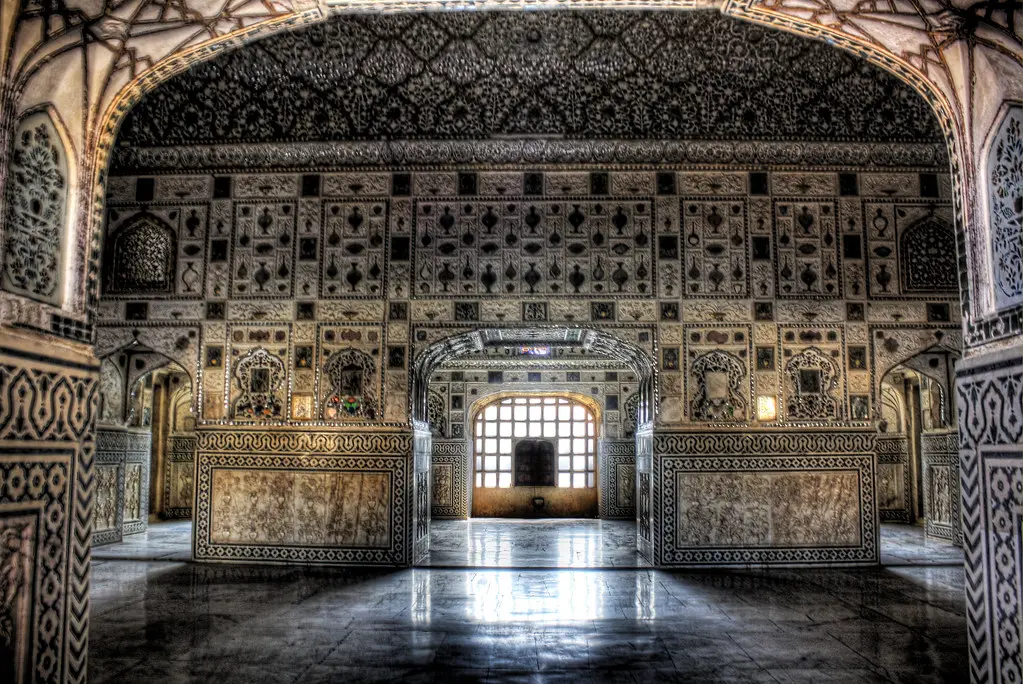
- Scale and architecture: The fort spreads across four interlocking courtyards, each with its own character. The Sheesh Mahal alone, with thousands of mirror pieces set into every surface of its ceiling and walls, is worth the journey from anywhere in India.
- History with real depth: Built in 1592 by Raja Man Singh I and expanded over generations, Amber Fort tells 135 years of Kachwaha Rajput history across its walls, gateways, and palaces before the court moved to Jaipur city in 1727.
- Setting: The fort sits on a hill above Maota Lake, with Jaigarh Fort visible on the ridge directly above. The combined view from the approach road is one of the most photographed heritage landscapes in India.
- The light and sound show: The evening show at Kesar Kyari Garden, with Amitabh Bachchan’s narration and the fort illuminated against the night sky, adds a dimension to the visit that daytime alone cannot provide.
- Accessibility: Unlike many Rajasthan forts, Amber Fort is fully accessible by road from Jaipur city in under 45 minutes, making it a practical addition to any Rajasthan itinerary regardless of base city.
Amber Fort sits on Cheel Ka Teela hill in the Aravalli ranges, about 11 km north of Jaipur city. Its hilltop position means it catches more wind than the city below, but it also means the open sandstone courtyards absorb and radiate heat intensely during summer. The fort receives the same rainfall as Jaipur during the monsoon months of July to September, which transforms the surrounding Aravalli hills from brown to green but can make some surfaces slippery.
Jaipur’s desert climate produces extremes in both directions: winters can drop to 8°C on cold nights while summers regularly cross 42°C at peak hours. Knowing which hours and months to visit Amber Fort Jaipur makes a significant difference to how much of the fort you actually see and enjoy.
Winter at Amber Fort Jaipur: October to March
October to March is the best time to visit Amber Fort Jaipur without qualification. Daytime temperatures range from around 8°C on the coldest January nights to a comfortable 25°C at peak afternoon in October and March. The sun feels pleasant rather than punishing, clear blue skies make every photograph of the red sandstone and white marble sharply beautiful, and the evenings are cool enough to enjoy the light and sound show without discomfort.
- Temperature: 8°C to 25°C depending on month
- Weather: Clear skies, dry air, minimal rain
- Things to Do: Full fort exploration, Sheesh Mahal visit, light and sound show, Maota Lake views, Jaigarh Fort add-on
- Best for: First-time visitors, families, photographers, heritage travellers
- Avoid if: You dislike cold early mornings in December and January when the fort opens at 8 AM
December and January are the peak crowd months. Visitors arriving at the fort gates after 10 AM will encounter long queues and busy courtyards. Arriving at or just after 8 AM during these months gives you the first hour in near-solitude with extraordinary morning light on the Sheesh Mahal’s mirror work.
Summer at Amber Fort Jaipur: April to June
Summer at Amber Fort Jaipur is genuinely challenging. Temperatures climb from the low 30s in April to above 42°C in May and June, and the open sandstone courtyards retain and reflect heat at a level that makes prolonged midday visits uncomfortable for most people. That said, summer is not a reason to skip Amber Fort entirely if Jaipur is your only window.
- Temperature: 30°C to 45°C
- Weather: Intense sun, dry heat, occasional dust
- Things to Do: Early morning fort visit (8 AM to 10 AM), evening light and sound show, indoor sections like Sheesh Mahal and Diwan-i-Khas
- Best for: Budget travellers seeking lower hotel rates and fewer queues
- Avoid if: You are visiting with elderly family members, young children, or have low heat tolerance
The one clear advantage of a summer visit is reduced tourist crowds. April onwards sees a significant drop in visitor numbers, making it possible to explore the fort’s quieter corners and photograph the courtyards without other visitors in every frame. The light and sound show runs later in summer evenings, starting around 7:30 PM for the English show, which gives the temperature time to drop to a more comfortable level.
Monsoon at Amber Fort Jaipur: July to September
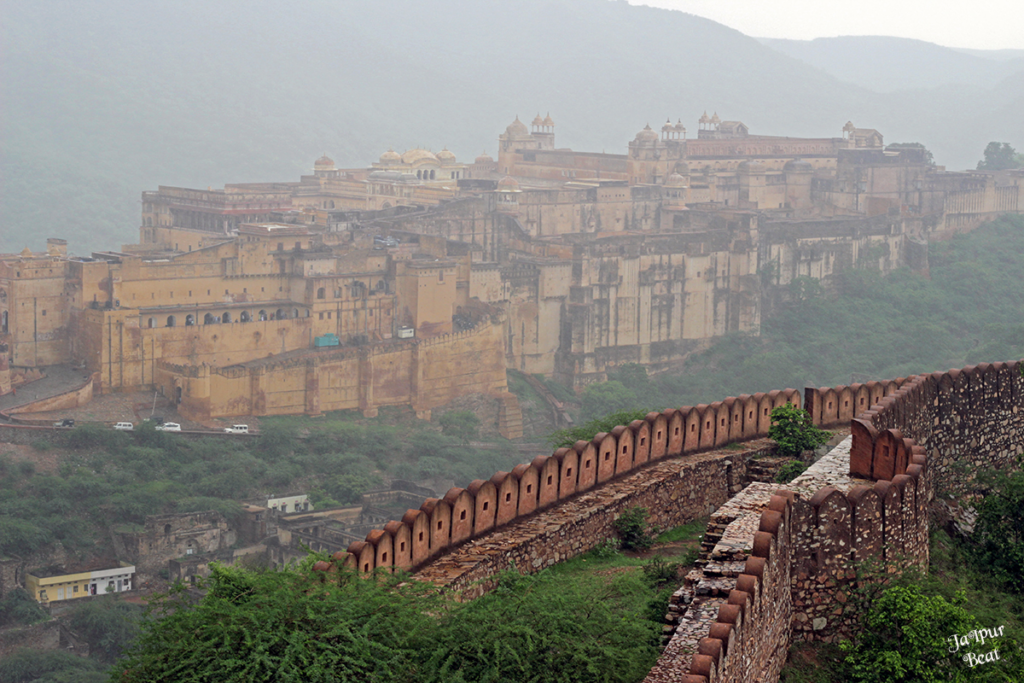
Monsoon at Amber Fort Jaipur produces some of the most dramatic scenery of any season. The Aravalli hills surrounding the fort turn vivid green, the Maota Lake fills up completely creating mirror-like reflections of the fort walls, and the early morning light after overnight rain is exceptional for photography. The trade-off is humidity, occasional heavy rain that can make the steep pathways slippery, and the risk of some access points being temporarily restricted.
- Temperature: 25°C to 35°C
- Weather: Humid, intermittent rain, dramatic skies, lush green surroundings
- Things to Do: Photography of the fort reflected in Maota Lake, indoor sections, early morning visits on dry days
- Best for: Photographers, offbeat travellers, those visiting Jaipur during holidays with no choice of timing
- Avoid if: You are trekking the full fort perimeter or planning to use the elephant ride route, which may be restricted in heavy rain
The monsoon months also overlap with the Teej festival celebrated in Jaipur in July and August, which adds a cultural dimension to a Jaipur visit during this period.
Post-Monsoon at Amber Fort Jaipur: October to November
October and November represent a sweet spot for the best time to visit Amber Fort Jaipur. The rains have ended, the surrounding hills are still green from the monsoon, tourist crowds have not yet reached their December peak, and temperatures sit in a very comfortable 18°C to 30°C range. Hotel rates are generally lower than December and January. The post-monsoon air clarity produces some of the sharpest distant views from the fort’s upper ramparts across the Aravalli ridges.
- Temperature: 18°C to 30°C
- Weather: Clear, dry, moderate temperatures, residual green landscape
- Things to Do: Full fort exploration, rampart walks, Jaigarh Fort add-on, Maota Lake boat views
- Best for: Photographers, couples, solo travellers, those wanting peak season quality without peak season crowds
- Avoid if: You want the full winter festival calendar, which peaks in December and January
What to See Inside Amber Fort Jaipur
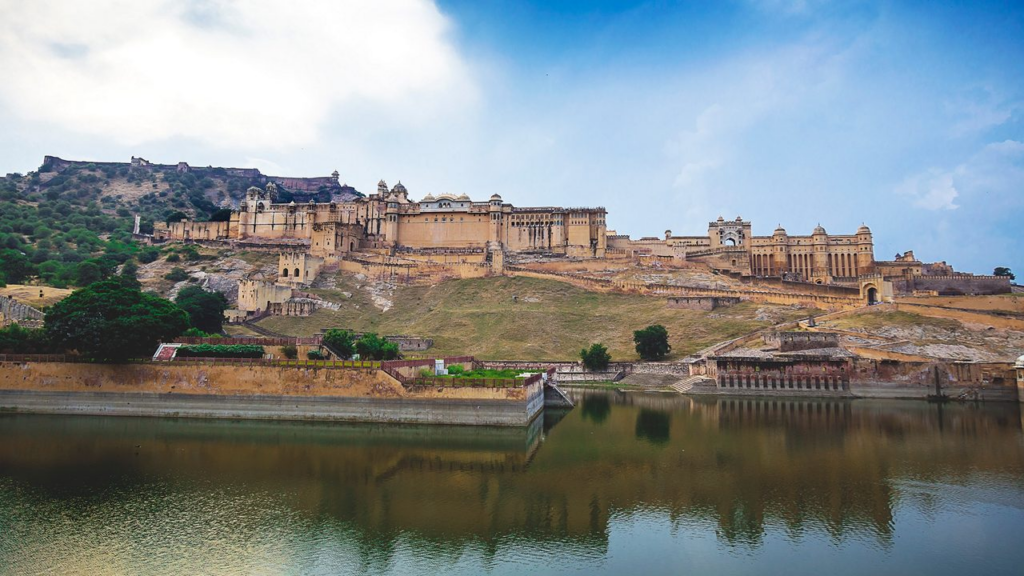
Amber Fort Jaipur is divided into four main courtyards, each holding key structures that deserve individual time. A complete visit takes 2 to 3 hours at a comfortable pace, longer with a guide.
The fort was built in 1592 by Raja Man Singh I of the Kachwaha Rajput dynasty and expanded significantly by his successors. It served as the primary royal residence before Sawai Jai Singh II moved the capital to Jaipur city in 1727. In 2013, Amber Fort was declared a UNESCO World Heritage Site as part of the Hill Forts of Rajasthan.
Key attractions inside the fort:
- Jaleb Chowk: The first and largest courtyard, where the army assembled after returning from battle. The main Suraj Pol (Sun Gate) opens into this vast space.
- Sheesh Mahal (Mirror Palace): The most-photographed interior in the entire fort. Thousands of tiny mirrors set into the walls and ceiling create a dazzling light-multiplying effect. A single candle flame can illuminate the entire chamber.
- Ganesh Pol: The most ornately decorated gateway inside the fort, painted with intricate frescoes and leading to the private royal quarters. Widely regarded as one of the most beautiful gates in India.
- Diwan-i-Khas (Hall of Private Audience): The intimate royal meeting hall with marble columns and pietra dura inlay work.
- Sukh Niwas: A palace room designed with an ingenious water-cooling system that kept the chamber comfortable even in Jaipur’s intense summers.
- Sila Devi Temple: An active temple within the fort dedicated to Goddess Durga, visited by pilgrims alongside tourists throughout the day.
- Zenani Deohri: The grand entrance to the zenana (women’s quarters), with elaborate lattice screens that allowed the royal women to observe the courtyard unseen.
Best Time of Day to Visit Amber Fort Jaipur
The time of day matters as much as the season for the best time to visit Amber Fort Jaipur.
Early morning (8 AM to 10 AM) is the best time for photography, cool temperatures, and minimal crowds. The golden morning light hits the sandstone at a low angle, the Sheesh Mahal mirrors are at their most brilliant, and the Maota Lake below reflects the fort in near-perfect stillness. Elephant rides are available at this time and stop by midday, so early arrivals have the best access.
Late afternoon (3 PM to 5:30 PM) works well from October to March when the worst of the day’s heat has passed. The warm afternoon light on the western-facing sandstone walls is excellent for photography, and the fort closes at 5:30 PM giving you time to settle for the evening light and sound show.
Evening (light and sound show) runs from 6:30 PM in winter. The show lasts 52 minutes, narrates the history of the Kachwaha dynasty across 600 years, and features narration by Amitabh Bachchan in the Hindi version with Gulzar’s script and music by Ustad Sultan Khan and Shubha Mudgal. The venue is the Kesar Kyari Garden at Maota Lake, where the fort and Jaigarh Fort behind it are visible simultaneously as the lighting display unfolds.
Amber Fort Jaipur Entry Fee and Timings
- Fort timings: 8:00 AM to 5:30 PM daily
- Entry fee (Indians): Rs 100 per person
- Entry fee (foreigners): Rs 500 per person
- Composite ticket covering Amber Fort, Jantar Mantar, Hawa Mahal, Albert Hall Museum, and Nahargarh Fort: Rs 400 (Indians) / Rs 1,000 (foreigners)
- Light and sound show: Rs 200 (English) / Rs 100 (Hindi); show timings change by season
- Light and sound show timings: October to February: 6:30 PM (English), 7:30 PM (Hindi); March to April: 7:00 PM (English), 8:00 PM (Hindi); May to September: 7:30 PM (English), 8:30 PM (Hindi)
- Elephant ride: Rs 1,100 for two people; available only in the morning until approximately noon
How to Reach Amber Fort Jaipur
How do you get to Amber Fort from Jaipur city?
Amber Fort is 11 km north of Jaipur city centre on NH-48. The drive takes 25 to 40 minutes depending on traffic. App cabs via Ola or Uber are the most convenient option. RSRTC buses and local city buses run frequently from Ajmeri Gate, Hawa Mahal, and Jaipur Railway Station to Amer and drop you near the fort ticket office.
How far is Amber Fort from Jaipur Railway Station?
Jaipur Junction is approximately 11 to 13 km from Amber Fort. The journey by cab takes 30 to 45 minutes. Hawa Mahal is just 7 to 8 km away, making it practical to combine both in a single day.
Which airport serves Amber Fort Jaipur?
Jaipur International Airport is approximately 20 km from Amber Fort, taking 35 to 50 minutes by road. Direct taxis and cab services connect the airport to the fort without requiring a stop in the city centre. Travellers flying from Mumbai can also check our India tour packages from Mumbai for curated Rajasthan itineraries that include Amber Fort.
Places to See Near Amber Fort Jaipur
Amber Fort sits in a heritage corridor that holds several more sites within a short distance.
- Jaigarh Fort: Directly above Amber Fort on the ridge, connected by a secret passage originally used by the royal family during sieges. Houses the world’s largest cannon on wheels. Add 1 to 2 hours for a combined visit.
- Jal Mahal: The water palace visible from the road on the way from Jaipur city, set in the middle of Man Sagar Lake. Best viewed from the lakeside road.
- Nahargarh Fort: Sits on the Aravalli Hills above Jaipur city with panoramic views of the entire pink city skyline, particularly striking at sunset.
- Panna Meena Ka Kund: A geometric stepwell a short walk from the Amber Fort ticket area. One of Jaipur’s most architecturally striking and undervisited heritage sites.
For a wider look at what Jaipur hides beyond the main monuments, our guide to hidden places in Jaipur covers the lesser-known corners of the city. If you are building a broader Rajasthan itinerary, our offbeat places in Rajasthan guide takes you well beyond the Golden Triangle circuit. And for those travelling from Mumbai, our Rajasthan group tour packages from Mumbai cover curated itineraries that include Amber Fort as part of a complete Rajasthan trip.
Practical Tips for Visiting Amber Fort Jaipur
These tips will help you plan the best time to visit Amber Fort Jaipur regardless of which season you choose.
- Arrive at or just after 8 AM to beat both the heat and the crowds. This applies in every season.
- Wear comfortable closed footwear. The fort involves steep ramps, uneven cobblestones, and a significant amount of walking across its four courtyards.
- Carry water and sun protection. The open courtyards offer minimal shade and the sandstone retains heat significantly.
- Hire a certified government-approved guide at the fort entrance for the best experience. The fort’s architecture, history, and hidden details require context that audio tours alone cannot fully provide.
- Book the composite ticket if you are visiting multiple Jaipur monuments on the same trip. It covers five sites including Amber Fort and saves significantly on individual entry fees.
- Elephant rides are available on a first-come, first-served basis and only in the morning. Arrive early if this is important to your visit.
- Visit on weekdays rather than weekends to avoid the rush of domestic tourists from Jaipur and surrounding cities.
- The light and sound show venue is at Kesar Kyari Garden on Maota Lake, a short distance from the fort entrance. Check seasonal show timings before planning your evening.
- Travelling with a group from Mumbai? Our group tour packages from Mumbai include Jaipur and Amber Fort as part of fully planned Rajasthan group itineraries.
Conclusion
The best time to visit Amber Fort Jaipur is October to March, with October and November offering the ideal combination of green post-monsoon surroundings, comfortable temperatures, and smaller crowds. December and January are peak season with the most cultural activity in Jaipur but also the busiest mornings at the fort gates. Summer and monsoon visits are viable with the right timing and preparation. Regardless of season, arriving early in the morning transforms the experience at Amber Fort, giving you the Sheesh Mahal, the Ganesh Pol, and the views over Maota Lake in the kind of quiet that this extraordinary UNESCO World Heritage Site deserves.

Frenzy Holidays ensures a smooth and enriching travel experience from start to finish. You can visit us at Haware Centurion, S07/34, Nerul East, Sector 19A, Nerul, Navi Mumbai, Maharashtra 400706. For bookings or more information, call +91 7400453140, email [email protected], or visit www.frenzyholidays.com. Pack up and explore India with Frenzy Holidays for an unforgettable journey.
Best Time to Visit Amber Fort Jaipur: FAQs
What is the best time to visit Amber Fort Jaipur?
October to March. Cool temperatures, clear skies, and the best photography light make this the ideal window.
What are the opening timings of Amber Fort Jaipur?
8:00 AM to 5:30 PM daily. The light and sound show starts from 6:30 PM in winter.
What is the entry fee for Amber Fort Jaipur?
Rs 100 for Indians, Rs 500 for foreigners. A composite ticket covering five Jaipur monuments costs Rs 400 (Indians) and Rs 1,000 (foreigners).
Is Amber Fort worth visiting in summer?
Yes, if you arrive at 8 AM before the heat peaks. Avoid midday visits from April to June entirely.
How much time do you need inside Amber Fort Jaipur?
2 to 3 hours at a comfortable pace, or 3 to 4 hours with a guide covering all four courtyards.
Is the Amber Fort light and sound show worth watching?
Yes. The 52-minute show features Amitabh Bachchan’s narration and Gulzar’s script, with the fort and Jaigarh illuminated and reflected in Maota Lake.
What is the best time of day to visit Amber Fort Jaipur?
8 AM to 10 AM in every season. Cool temperatures, softest light, and smallest crowds make early morning the clear winner.
Can you visit Amber Fort during monsoon?
Yes. The Aravalli hills turn green and Maota Lake fills beautifully. Carry a rain jacket and stick to dry mornings.
How do I reach Amber Fort from Jaipur city?
By app cab (Ola or Uber) in 25 to 45 minutes. City buses from Hawa Mahal and Jaipur Railway Station also run to Amer.
What is the difference between Amber Fort and Jaigarh Fort?
Amber Fort was the royal palace; Jaigarh Fort above it was the military stronghold. Both are connected by a secret passage and can be visited together.
