
Planning a pilgrimage to Dwarka, one of Hinduism’s four sacred Char Dham destinations and the legendary kingdom of Lord Krishna on the shores of the Arabian Sea in Gujarat, requires far more careful timing than most religious journeys in India. The Dwarkadhish Temple, the magnificent 5th century Jagat Mandir rising 51.8 metres above the Gomti River confluence with the sea, experiences dramatic seasonal shifts in climate, crowd intensity, and festival energy that profoundly affect the quality and comfort of your darshan experience.
This comprehensive guide covers season-wise analysis, dwarka climate patterns month by month, complete dwarka timings for darshan and aarti, logistics including nearest airport to dwarkadhish temple, and everything needed for a deeply rewarding Char Dham pilgrimage.
Confused where to go for quick escape? Let us plan it for you.
Grab the Best DealTable of Contents
Dwarka Temple Visit Planning : Quick Overview
| Season | Best Months | Temperature | Conditions | Ideal For |
|---|---|---|---|---|
| Winter | Oct–Feb | 15–28°C | Cool, pleasant, clear | Comfortable darshan, all pilgrims |
| Spring | Mar–Apr | 22–34°C | Warm, manageable | Budget travel, moderate crowds |
| Summer | May–Jun | 30–42°C | Hot and humid | Avoid if heat-sensitive |
| Monsoon | Jul–Sep | 26–33°C | Heavy rain, rough sea | Janmashtami (Aug), lush scenery |
You can also explore our affordable Rajasthan Tour Package designed for Budget Travellers.
Best Time to Visit Dwarka Temple: Seasonal Analysis
The best time to visit Dwarka temple balances dwarka climate comfort with the Hindu religious calendar, since festivals, auspicious tithis, and Ekadashi dates draw enormously varied crowd levels and create dramatically different darshan experiences across the year.
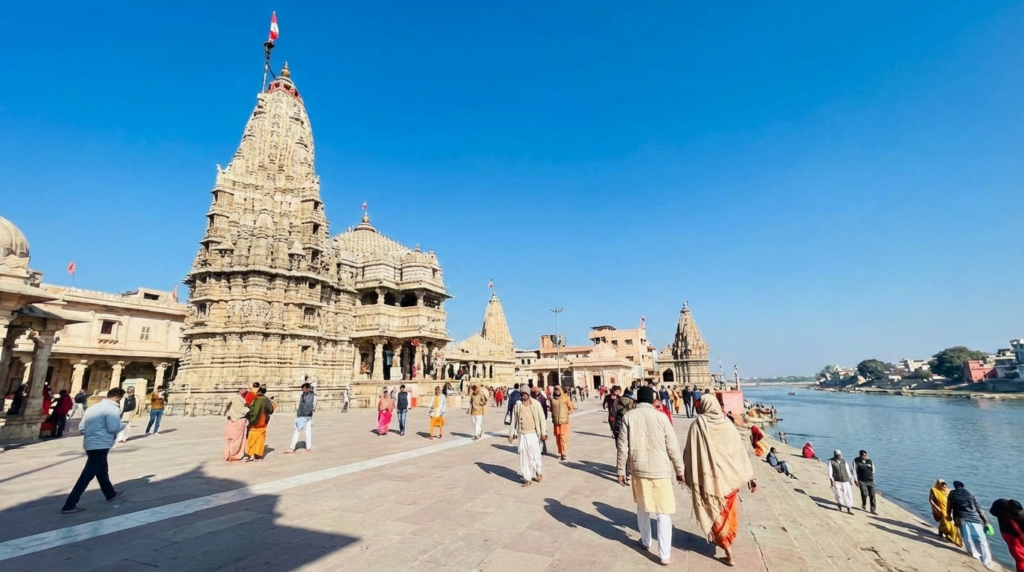
October to February: The Best Time to Visit Dwarka Temple
The post-monsoon and winter months represent the best time to visit Dwarka temple for the vast majority of pilgrims and first-time visitors. The monsoon has retreated, dwarka climate settles into its most pleasant range, and the Arabian Sea returns to a calm, photogenic state that makes the Dwarkadhish Temple’s clifftop setting at the Gomti Ghat appear at its most majestic.
Dwarka Climate (October–February):
- October: 22–30°C, post-monsoon clarity, excellent conditions
- November: 18–28°C, pleasant and clear, ideal for darshan
- December: 15–25°C, cool and comfortable, peak pilgrimage season
- January: 13–24°C, coolest month, busy with winter pilgrims
- February: 15–26°C, warming gently, excellent conditions throughout
Why This Season Excels:
- Dwarkadhish Temple during winter mornings offers a peaceful and spiritual atmosphere with mist over the Gomti River, along with the sound of temple bells and conch shells.
- The cool winter climate makes it comfortable to attend darshan, walk between Rukmini Devi Temple and Gomti Ghat, and participate in aarti ceremonies.
- December and January are the peak months, attracting pilgrims from across states like Gujarat, Rajasthan, and Maharashtra.
- It is advisable to book accommodation in advance, especially during the festive and holiday season.
- Despite heavy crowds, the overall spiritual experience remains highly fulfilling.
- Nearby attractions like Shankhodhara Beach, Nageshwar Jyotirlinga Temple, and Beyt Dwarka are best explored during winter due to pleasant weather conditions.
Ideal For: All first-time pilgrims, families, senior citizens, devotees completing Char Dham Yatra, photography seekers.
Trip Cost (Peak Winter): ₹8,000–16,000 per person for 3N/4D including accommodation, local transport for Dwarka darshan circuit, and Somnath day trip.
March to April: Shoulder Season for Budget Pilgrims
March and early April offer a workable pilgrimage window that combines manageable dwarka climate conditions with noticeably lower costs and reduced queues at the Dwarkadhish Temple. This is a particularly good period for pilgrims who have flexibility in their travel dates and want a more contemplative, less crowded darshan experience.
Dwarka Climate (March–April):
- March: 20–32°C, warm mornings, comfortable for darshan
- April: 24–36°C, rising heat, confine outdoor activity to mornings and evenings
What to Expect:
- The first two weeks of March are ideal for visiting Dwarkadhish Temple, with normal temple timings and aarti schedules.
- Accommodation prices are 20–30% lower compared to peak winter season.
- Crowds are relatively less, allowing faster darshan and a more peaceful experience.
- The festival of Holi in March is celebrated with great devotion in Dwarka, making it a special time for pilgrims.
- By April, temperatures rise (around 34–38°C), making afternoons quite hot.
- It is best to attend morning darshan (6–7 AM), rest during midday heat, and return for evening aarti near sunset for a comfortable experience.
Ideal For: Budget pilgrims, solo travelers, repeat visitors, those avoiding peak season crowds.
Trip Cost (Shoulder Season): ₹6,500–11,000 per person for 3N/4D.
May to June: Summer Heat
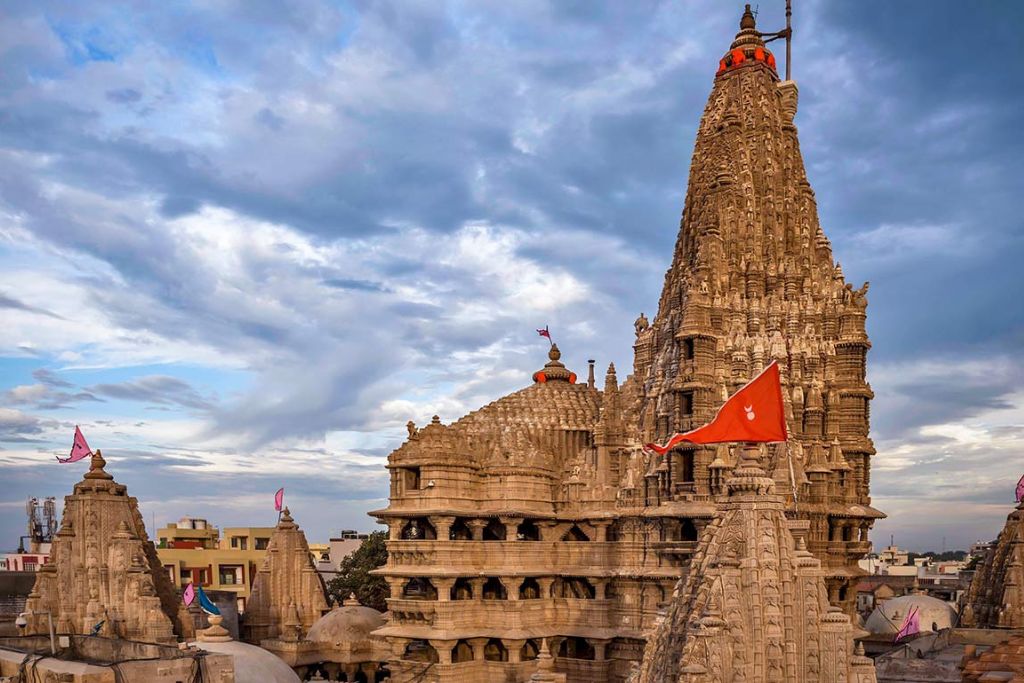
May and June bring Dwarka’s most challenging dwarka climate conditions. The coastal location adds humidity to the heat, and the combination of 38–42°C temperatures with Arabian Sea humidity makes extended outdoor pilgrimage activity genuinely draining. The Dwarkadhish Temple complex involves considerable open-air walking across stone courtyards that heat intensely by mid-morning, making summer visits demanding for most pilgrims.
Dwarka Climate (May–June):
- May: 30–40°C, hot and humid
- June: 28–38°C, pre-monsoon heat building with early showers
Who Might Still Visit:
- Pilgrims following fixed religious dates, Char Dham Yatra schedules, or strong devotional commitments often visit Dwarka even during summer.
- Dwarkadhish Temple remains open throughout the year with regular darshan and aarti timings.
- The spiritual experience inside the temple remains unchanged regardless of weather conditions.
- It is advisable to plan outdoor activities only during early morning (5:30–9:30 AM) and evening (5:00–8:00 PM) to avoid extreme heat.
Trip Cost (Summer): ₹5,000–8,000 per person for 3N/4D, lowest accommodation rates of the year.
July to September: Monsoon and the Unmissable Janmashtami
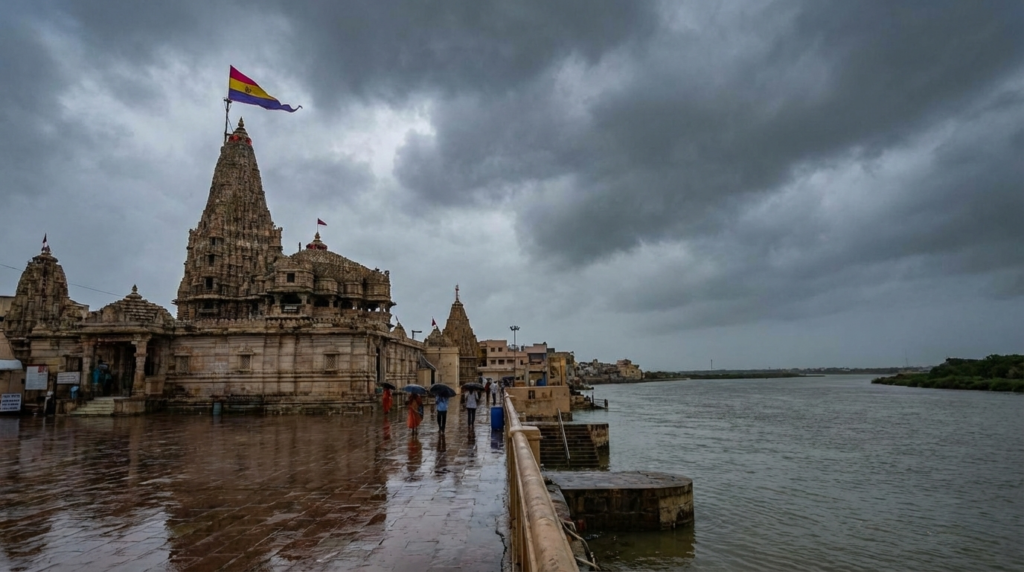
The southwest monsoon arrives on Dwarka’s Arabian Sea coast in late June and brings heavy rainfall, rough seas, and dramatically lush surroundings through September. The dwarka climate during this period is warm and very humid, with periodic heavy downpours. The Gomti Ghat and seafront areas can flood during peak rainfall days, and boat services to Beyt Dwarka are frequently suspended due to rough seas.
Dwarka Climate (July–September):
- July: 27–33°C, heavy rainfall, rough Arabian Sea
- August: 26–32°C, continuing monsoon, Janmashtami peak
- September: 26–32°C, monsoon easing gradually
Janmashtami: The Defining Reason to Visit in Monsoon:
- Even though monsoon weather can be challenging, August sees the biggest gathering in Dwarka due to Janmashtami celebrations.
- Dwarkadhish Temple celebrates Lord Krishna’s birth with grand rituals like midnight abhishek, special aarti, and temple illumination.
- The atmosphere at Gomti Ghat becomes highly spiritual, with thousands of devotees gathering and chanting through the night.
- It is recommended to book accommodation 3–4 months in advance, as the town gets fully occupied during this time.
- Arriving 2 days before Janmashtami helps in experiencing all rituals, including pre-festival celebrations like Gokulashtami.
Ideal For: Devoted pilgrims specifically for Janmashtami, budget travelers comfortable with monsoon conditions.
Trip Cost (Janmashtami Week): ₹10,000–18,000 per person for 3N/4D due to massive demand surge; ₹6,000–9,000 in non-festival monsoon weeks.
Dwarka Climate: Month-by-Month Breakdown
| Month | Min Temp | Max Temp | Rainfall | Recommendation |
|---|---|---|---|---|
| January | 13°C | 24°C | Nil | ✅ Excellent |
| February | 15°C | 26°C | Nil | ✅ Excellent |
| March | 20°C | 32°C | Nil | ✅ Very Good |
| April | 24°C | 36°C | Nil | ✔️ Good |
| May | 28°C | 40°C | Nil | ❌ Avoid if possible |
| June | 27°C | 38°C | Starts | ❌ Avoid if possible |
| July | 27°C | 33°C | Heavy | ⚠️ Janmashtami only |
| August | 26°C | 32°C | Heavy | ⚠️ Janmashtami peak |
| September | 26°C | 32°C | Moderate | ⚠️ Easing |
| October | 22°C | 30°C | Nil | ✅ Excellent |
| November | 18°C | 28°C | Nil | ✅ Excellent |
| December | 15°C | 25°C | Nil | ✅ Excellent |
Dwarka Temple Aarti Time & Darshan Timings
Accurate dwarkadhish temple opening time and dwarka temple aarti time information is essential for pilgrimage planning, as these schedules govern the entire rhythm of a Dwarka visit.
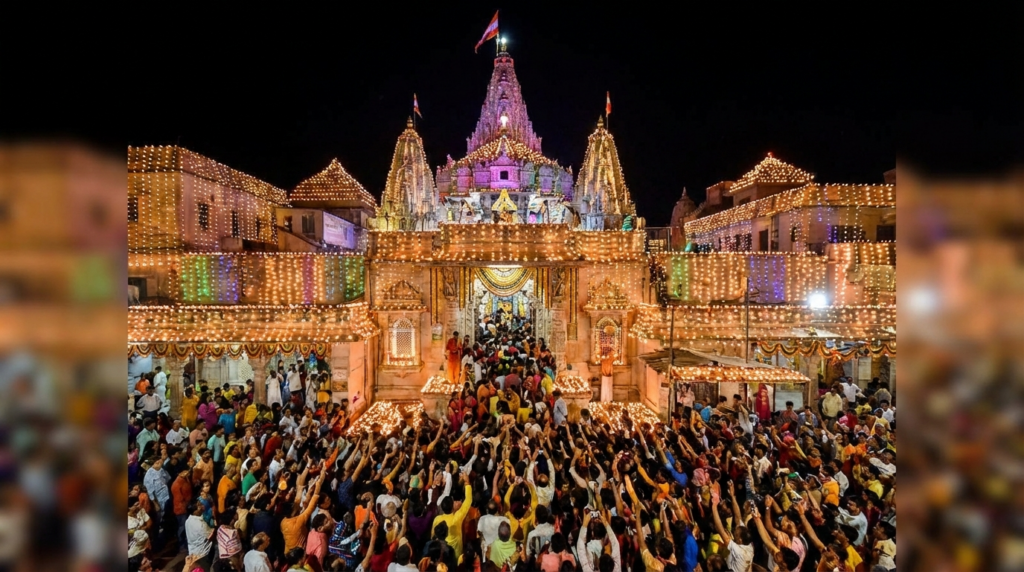
Dwarkadhish Temple Opening Time and Dwarka Timings:
- Dwarkadhish Temple has two main darshan sessions daily.
- Morning Darshan: 6:30 AM – 12:30 PM
- Evening Darshan: 5:00 PM – 9:30 PM
- The schedule follows traditional Vaishnava rituals, with a midday break for the Lord’s rest (Madhyanha).
- Timings may vary slightly depending on season and festivals.
- It is advisable to check the latest schedule with the temple authority before planning your visit.
Dwarka Temple Aarti Time Schedule:
- Dwarkadhish Temple follows a traditional Vaishnavite Ashtayam puja system with multiple aarti ceremonies throughout the day.
- Key aarti timings include:
- Mangala Aarti: 6:30 – 7:00 AM
- Rajbhog Aarti: 10:30 – 11:00 AM
- Sandhya Aarti: 7:00 – 7:30 PM
- Shayan Aarti: 8:30 – 9:00 PM
- Among these, the Sandhya Aarti (evening aarti) is the most popular and spiritually enriching for visitors.
- During this time, the temple lights up beautifully and Gomti Ghat fills with devotees, creating a powerful devotional atmosphere.
- It is recommended to arrive at least 45 minutes early to get a good spot for the aarti experience.
Dress Code and Entry Rules:
- Entry into the inner sanctum of Dwarkadhish Temple requires removal of leather items such as belts and wallets.
- Visitors are expected to wear modest or traditional attire while entering the temple.
- Mobile phones and cameras are generally not allowed inside the premises.
- Separate queues are arranged for men and women to manage crowd flow.
- During peak times, pilgrims can opt for special darshan tickets for quicker access, available at the temple trust counter near the entrance.
Dwarkadhish Temple Trust Accommodation
The dwarkadhish temple trust accommodation system is among the most organised in any major pilgrimage town in Gujarat, offering clean, affordable rooms directly managed by the Shri Dwarkadhish Temple Trust in close proximity to the main temple.
Dwarkadhish Temple Trust Accommodation Options:
- The Dwarkadhish Temple Trust offers dharamshalas and rest houses at different price ranges.
- Dormitory stays: ₹200–400 per person per night
- Private rooms: ₹600–1,200 per night (double occupancy)
- The biggest advantage is the location, as most accommodations are within 5–10 minutes walking distance of Dwarkadhish Temple.
- Bookings can be made directly at the trust office near the temple.
- During peak periods like December–January, Janmashtami, Holi, and Ekadashi, it is best to book 4–6 weeks in advance.
- In off-season months, walk-in bookings are usually available.
- Apart from trust stays, Dwarka also offers private hotels and guesthouses:
- Budget: ₹800–1,500 per night
- Mid-range: ₹2,000–4,000 per night
- Premium: ₹5,000–8,000 per night
- The area near Gomti Ghat and around the temple has the highest concentration of accommodation options for pilgrims.
How to Reach Dwarkadhish Temple
How to Reach Dwarkadhish Temple By Air
- The nearest airport to Dwarkadhish Temple is Jamnagar Airport, located about 137 km away. It has limited connectivity, mainly with Mumbai.
- Taxi cost: ₹2,500–3,000
- Travel time: 2.5–3 hours
- A more convenient option is Rajkot Airport, around 215 km from Dwarka, with better flight connections to major cities like Mumbai and Ahmedabad.
- Taxi cost: ₹3,500–4,500
- Travel time: 3.5–4 hours
- For the best connectivity, travelers can choose Sardar Vallabhbhai Patel International Airport, located about 430 km away. It connects to major cities like Delhi, Bengaluru, Chennai, and Mumbai.
- From Ahmedabad, pilgrims usually take overnight trains or buses to reach Dwarka conveniently.
How to Reach Dwarkadhish Temple By Train
Dwarka Railway Station is on the Ahmedabad-Okha broad gauge line with direct trains from Ahmedabad (7–8 hours, Saurashtra Mail and Okha Express are popular services), Mumbai (overnight trains via Rajkot), and Jamnagar. The train is the most popular and cost-effective option for pilgrims from across Gujarat and Mumbai.
How to Reach Dwarkadhish Temple By Road
Dwarka is well-connected by road to Porbandar (100 km), Jamnagar (137 km), Rajkot (215 km), and Ahmedabad (430 km) via NH47. Gujarat State Road Transport Corporation (GSRTC) operates regular bus services, and private Volvo buses run overnight routes from Ahmedabad and Rajkot.
Combining Dwarka with a Broader Gujarat Pilgrimage Itinerary
Dwarka’s position on the Saurashtra peninsula places it within a natural pilgrimage and heritage circuit that can be meaningfully expanded for travelers with additional days.
Somnath, the first Jyotirlinga and one of India’s most significant pilgrimage sites, is 232 km from Dwarka and combines naturally into a 5–6 day Saurashtra pilgrimage that covers both Char Dham and Jyotirlinga traditions. Our comprehensive guide to places to visit in Somnath and Dwarka covers the complete circuit in detail.
Gujarat’s extraordinary heritage depth extends far beyond the pilgrimage circuit. Our guide to hidden places in Gujarat reveals lesser-known temples, archaeological sites, and natural wonders across the state that complement a Dwarka visit beautifully for travelers with time to explore. The ancient port city of Khambhat, with its extraordinary archaeological significance and distinctive craft traditions, is worth including in a broader Gujarat itinerary and our resource on places to visit in Khambhat covers it comprehensively. For travelers extending further, the places to visit in Statue of Unity guide covers the Kevadia region around the world’s tallest statue, which pairs well with an Ahmedabad base on the onward or return journey.
Essential Dwarka Temple Travel Tips
Pilgrimage timing strategy: The Dwarkadhish Temple is busiest on Ekadashi (the 11th day of each lunar fortnight), Janmashtami, Diwali, and Holi. If your primary goal is peaceful, unhurried darshan rather than the festival experience, plan your visit on ordinary weekday tithis in the October–February window.
Footwear management: The distance from most accommodation to the temple involves considerable barefoot walking on stone paths during the final approach. Carry a small bag for footwear at the entrance and wear comfortable footwear that is easy to remove and carry.
Gomti Ghat ritual: The sacred Gomti Ghat at the base of the temple receives pilgrims for ritual bathing before darshan. This practice is most comfortable and meaningful in winter and spring months. The ghat steps can be slippery and the current unpredictable, so exercise caution particularly with children and elderly family members.
Beyt Dwarka excursion: The boat trip from Okha jetty (30 km from Dwarka) to Beyt Dwarka island (15 minutes by boat) is a worthwhile excursion covering the island temple where Krishna is believed to have resided. Boat services operate only in calm sea conditions, making October–April the reliable window for this trip.
Local food: Dwarka being a pilgrimage town follows strict vegetarian norms. Sattvic Gujarati thali meals at local restaurants offer exceptional value (₹100–200 for a full meal). The town’s sweet shops carry excellent Krishna-themed prasad items including panchamrit, churma laddoo, and makhan mishri.
Conclusion.
The best time to visit Dwarka temple for most pilgrims is October through February, when dwarka climate settles into a comfortable 13–28°C range, darshan queues are manageable, and the full experience of dwarkadhish temple opening time, dwarka temple aarti time ceremonies, Gomti Ghat rituals, and coastal Gujarat scenery comes together in its most welcoming form. Planning around dwarka timings for morning and evening aarti sessions, securing dwarkadhish temple trust accommodation close to the sanctum, and understanding the nearest airport to Dwarkadhish Temple options for seamless arrival ensures a physically comfortable and spiritually deeply fulfilling Char Dham pilgrimage.

Frenzy Holidays ensures a smooth and enriching travel experience from start to finish. Visit us at Haware Centurion, S07/34, Nerul East, Sector 19A, Nerul, Navi Mumbai, Maharashtra 400706. For bookings or more information, call +91 7400453140, email [email protected], or visit www.frenzyholidays.com. Pack up and embark on your sacred Dwarka pilgrimage with Frenzy Holidays for an unforgettable spiritual journey.
Best Time to Visit Dwarka Temple – FAQs
What is the best time to visit Dwarka temple overall?
October to February is the best time to visit Dwarka temple for comfortable darshan in pleasant dwarka climate conditions of 13–28°C. November and December are particularly ideal, offering clear skies, calm Arabian Sea, and an excellent atmosphere for full pilgrimage activity.
What is the dwarkadhish temple opening time?
The dwarkadhish temple opening time is approximately 6:30 AM for the morning session (running until 12:30 PM) and 5:00 PM for the evening session (running until 9:30 PM). Timings vary slightly by season and festival days, so confirm current dwarkadhish temple opening time with the trust before visiting.
What is the dwarka temple aarti time?
The primary dwarka temple aarti time sessions are Mangala Aarti at approximately 6:30–7:00 AM and Sandhya Aarti at approximately 7:00–7:30 PM. The dwarka mandir aarti time for the evening Sandhya Aarti at sunset is the most atmospheric and most sought after by pilgrims. Arrive 45 minutes early for a good position at Gomti Ghat.
How do I book dwarkadhish temple trust accommodation?
Dwarkadhish temple trust accommodation is booked directly with the trust administration office near the temple complex. Options range from dormitory beds (₹200–400) to private rooms (₹600–1,200 per night). During peak season (December–January, Janmashtami), book dwarkadhish temple trust accommodation 4–6 weeks in advance.
What is the nearest airport to Dwarkadhish Temple?
The nearest airport to Dwarkadhish Temple is Jamnagar Airport (137 km). For better flight connectivity, Rajkot Airport (215 km) and Ahmedabad Airport (430 km) serve more routes and are preferred by most pilgrims arriving by air.
What is the dwarka climate like throughout the year?
Dwarka climate ranges from a cool 13°C in January nights to a hot 42°C in May afternoons. The coastal location keeps winters mild and pleasant (October–February), while summers are hot and humid (May–June). The best dwarka climate for comfortable pilgrimage is November through February.
Is Janmashtami a good time to visit Dwarka temple?
Yes, Janmashtami in August is the most spiritually significant time to visit Dwarka temple and draws lakhs of devotees for midnight ceremonies and special aarti. Despite monsoon conditions, the religious experience is extraordinary. Book accommodation 3–4 months in advance for Janmashtami.
What are the dwarka timings for the full darshan circuit?
A full Dwarka darshan circuit covering the Dwarkadhish Temple, Rukmini Devi Temple (2 km away), Nageshwar Jyotirlinga (16 km), and Gomti Ghat requires at least 2 full days. Most pilgrims plan 2 nights to cover dwarka timings across morning and evening aarti sessions without rushing.
Can I combine Dwarka with Somnath?
Yes, Somnath is 232 km from Dwarka and combines naturally into a 5–6 day Saurashtra pilgrimage. Our guide to places to visit in Somnath and Dwarka covers the complete circuit including temples, beaches, and heritage sites between both destinations.
What should I not miss during a Dwarka temple visit?
Beyond the Dwarkadhish Temple darshan itself, do not miss the Sandhya Aarti at Gomti Ghat at sunset, the Beyt Dwarka island boat trip (October–April), Nageshwar Jyotirlinga visit, and the Shankhodhara beach near Dwarka for a quiet Arabian Sea sunset.
